Background introduction The most common genetic alteration in oligodendroglioma is the loss of heterozygosity in the long arm (19q) of chromosome 19, which occurs between 50% and 80%, and the most common deletion region is 19q13.3. The second most common is the loss of heterozygosity in the short arm (1p) of chromosome 1, which occurs between 40% and 92%.

Dwarka Sector-7, New Delhi-110075
1p/19q gene deletion detection probe kit
Probe description
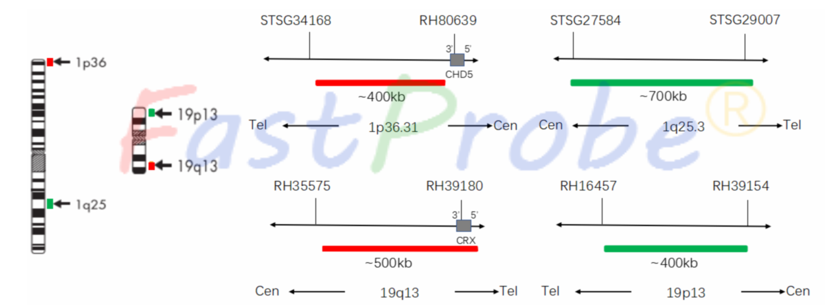
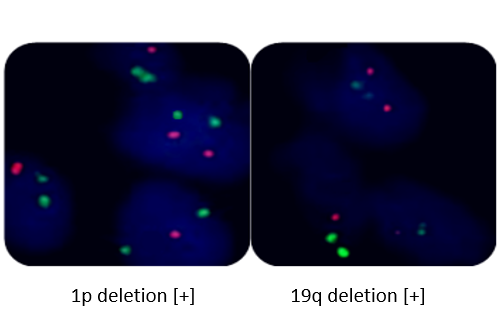
1p/19q deletion probe uses an orange dye to label the short arm p36 region of chromosome 1 and a green dye to label the long arm q13 region of chromosome 19.
Clinical significance
The detection of 1p/19q heterozygous deletion has important implications for clinical treatment guidance and prognosis of oligodendroglioma. 100% of patients with heterozygous deletions on chromosome 1p/19q were found sensitive to chemotherapy with PVC regimen, with an average survival of 10 years; the average survival of patients without such genetic alterations was only 2 years. The 1p/19q heterozygous deletion is an independent prognostic factor with significant prognosis, even in recurrent cases. 1p/19q heterozygous deletion is a specific molecular genetic alteration in oligodendroglioma, but it is not the only change, so detection of 1p/19q heterozygous deletion is not recommended for differential diagnosis alone. However, for patients with confirmed oligodendroglioma, detection of 1p/19q heterozygous deletions can provide valuable information to clinicians.

BRAF gene break apart detection probe (KIAA1549/BRAF gene fusion probe) kit
Background introduction BRAF gene is located in the q34 region of chromosome 7 and encodes a protein of 766 amino acid residues. It is a silk/threonine-specific kinase and is an important transduction factor in the RAS /RAF /MEK /ERK signaling pathway which regulates cell proliferation and division. The BRAF gene can be rearranged with multiple genes such as AKAP9, FCHSD1, and BTF3L4, and plays an important role in the development of tumors. KIAA1549 gene is located in the q34 region of chromosome 7, and the KIAA1549/BRAF fusion gene can occur in 60% to 80% of hair cell astrocytoma.
Probe description
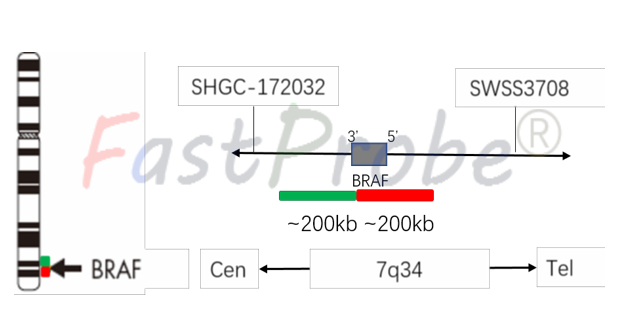
BRAF gene break apart probe (KIAA1549/BRAF gene fusion probe) uses an orange dye to mark the 5'end of BRAF gene and a green dye to mark the 3'end of BRAF gene. Because BRAF is close to KIAA1549 (2Mbp) and BRAF gene can be rearranged with multiple genes, conventional BRAF break probe and KIAA1549/BRAF gene fusion probe cannot completely distinguish positive and negative samples. This probe uses non-repetitive sequences probe to design BRAF cleavage probe. When BRAF rearrangement is negative, it shows a 2F signal. When BRAF gene is rearranged with other genes, it shows a typical 1R1G1F signal. When BRAF gene is fused with the KIAA1549 gene, it shows specific 1G2F signal.
Clinical significance
Hairy cell astrocytoma is a cystic astrocytoma with a clear border and slow growth that often occurs in children and young adults. It has been found that 60%-80% of hair cell astrocytoma patients have a KIAA1549/BRAF gene fusion, and the detection of this gene fusion by FISH has a differential significance in low-grade glioma.
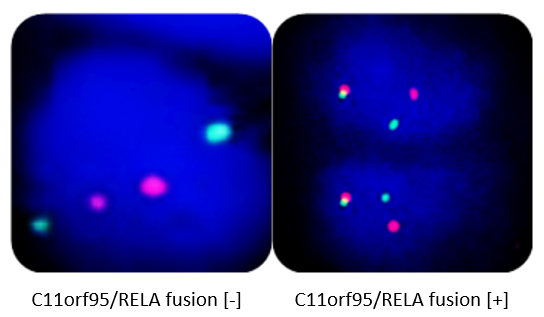
C11orf95/RELA gene fusion probe detection kit
RELA gene (also known as p65 or NFKB3) is located in the q13.1 region of chromosome 11, encoding a 551 amino acids NFKB transcription factor protein family member p65. The NFKB family regulates gene transcription and expression by binding to promoter and enhancer sequences of various genes, and participates in immune, inflammatory, stress and other processes, as well as regulating cell differentiation, proliferation, apoptosis and other processes. The C11orf95 gene is located in the q13.1 region of chromosome 11.
Probe description
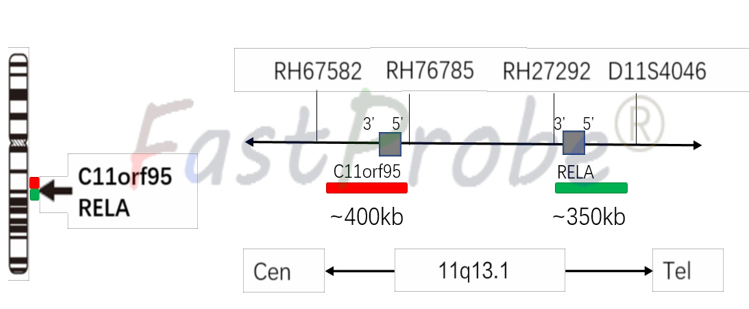
C11orf95/RELA gene fusion probe is labeled with an orange dye and the RELA gene is labeled with a green dye. Because of the close distance between C11orf95 and RELA genes (2Mbp), the conventional C11orf95/RELA fusion gene probe cannot completely distinguish positive and negative samples. This probe uses non-repetitive sequences probe to design C11orf95/RELA gene fusion probe, C11orf95/RELA gene fusion negative sample shows 2R2G signal and C11orf95/RELA gene fusion positive sample shows a typical 1R1G1F signal.
Clinical significance
70% of young patients with anterior ependymoma carry RELA mutations to form the C11orf95/RELA gene fusion, which can be used for differential diagnosis and prognosis of ependymoma.